The Book in Three Sentences
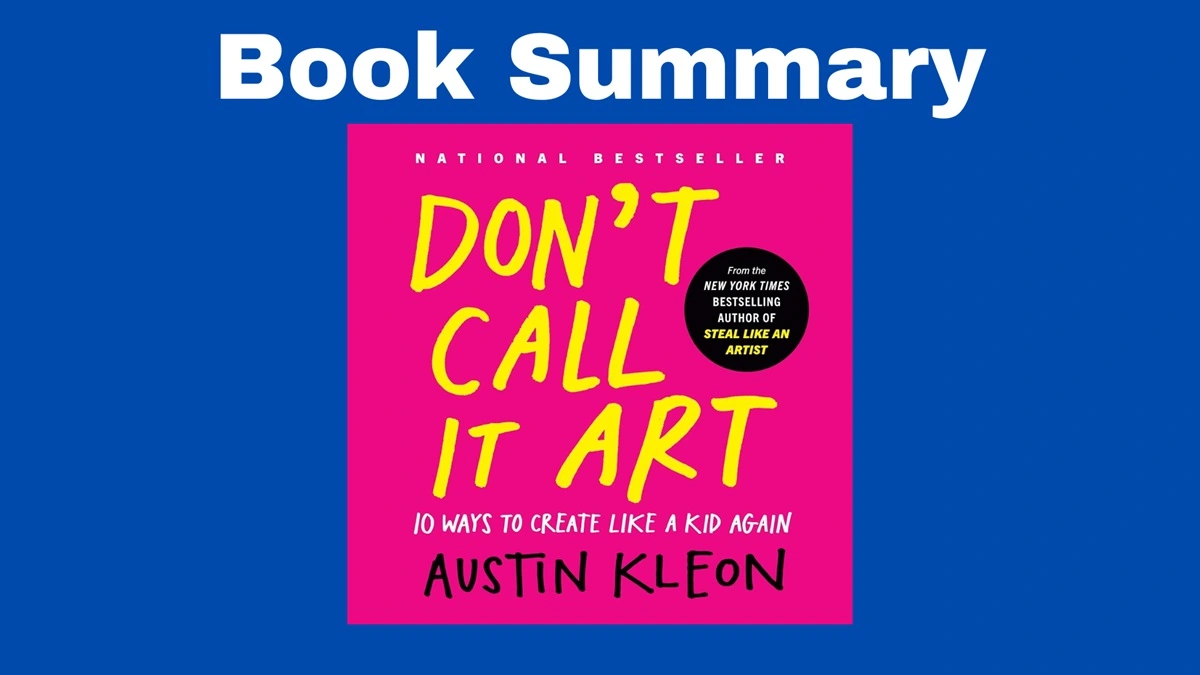
In this book summary of Don’t Call It Art, you’ll learn to look at the world and your creative work with fresh eyes. This book helps you recapture the energy, joy, and freedom you had when you started your creative journey. Through ten lessons, Austin Kleon teaches you everything he learned from his sons and how to apply that to your work.
To get better results in a creative field, we shouldn’t call it art. Children are naturally creative. Spending time with kids isn’t about learning; it’s about unlearning. We should treat ourselves the same way we treat our kids: we should play, get bored, limit our screen time, and go outside.
Chapter 1: Throw Out the Instructions
Not worrying about making art will make you great at it. There aren’t instructions to make art, and you don’t want to become your own critic either.
Not knowing what you’re doing leads to mistakes and, unironically, those mistakes lead to brilliance. If you don’t know what you can and can’t do, you’ll do it anyway. The important part is to stick with it long enough. As a creative person, you don’t want to know what you’re doing. That’s when you bore yourself and others.
Everyone pretends to know what they’re doing. In reality, nobody knows anything. You want to figure out how to stay a perpetual amateur. Since nobody knows anything, no one can tell you what to do, and you can do things your way.
Don’t look for advice or suggestions on how to do things. In the same way that there are no instructions on how to live life, no one can teach you how to be an artist. As a perpetual learner, you must find out things on your own. What you learn by yourself sticks with you.
We live in a world where information is abundant. What we lack is a sense of wonder. With this in mind, get frustrated, get lost, and discover things on your own.
Chapter 2: Don’t Take Things Too Seriously
Don’t look for successful people; look for the ones who seem to be having fun. Having fun and not taking things too seriously is a great philosophy for living life. Even in serious times, see life as a comedy. If you can laugh, you can survive. Play and improvise. Adapt to your circumstances.
We’re all familiar with the dramatic lives of artists who have suffered and died for their work. You don’t have to suffer to make art, though. If you treat life as a comedy, you might fail, but your ending will be happier.
One great way to have fun is by playing the fool. Children do this all the time, and they’re looking for adults who will join in on the fun. This is a great attitude toward life in general, and it’ll show in your creative work. Being a fool doesn’t mean being stupid. It just means not thinking too much. It means being optimistic. This takes more courage than you might think. Try new things, and do wild creative work.
Similarly, you should ask many questions. That’s how you really understand things. Kids do this all the time, and when you hang out with them, you’ll quickly understand you don’t know that much about anything. Kids don’t do this out of malice, but out of open-mindedness, innocence, and naivete. An exercise as simple as asking “why” five times in a row will solve most problems in life, not just creative ones.
Do what’s natural, not what others tell you is right. There is no right way to do things. There’s something magical in doing creative work, and if you lose it, it’s hard to get it back.
Chapter 3: Give Yourself Time, Space, and Materials
Both children and artists need time, space, and materials. Time should be uninterrupted, space inviting and comfortable, and materials plentiful. You need all three elements or else you won’t make anything.
- Time: when you’re so immersed in an activity that you forget about everything, including the passage of time, you are in a state of “flow”. With this in mind, schedule playtime. You’ll often get more “work” done when you’re playing than when you force yourself to work.
- Place: everyone needs a safe place to play. Creatives need a place to hide, somewhere they can get away from the world and enter a world of their own. You just need room. It could be as simple as a basement, attic, or desk. Whatever space you have, it has to be private.
- Materials: both artists and kids don’t need many things to play with. Something about the materials you use speaks to you and invites you to play. At their best, tools should feel like toys you can play with.
Chapter 4: Permission to Be Bad
As an artist, you’re allowed to experiment and do bad work. When you goof off and do something you’re not supposed to, that’s when you activate your creative self. Be willing to disappoint or horrify the most authoritative figure in your life, even if that person is you. Do what’s wrong and stupid, as long as it’s fun.
Supplies aren’t precious, so don’t worry about being perfect either. Embrace imperfectionism. Focus on quantity rather than quality. As counterintuitive as it sounds, quantity leads to quality. Use art supplies on whatever project you’re working on.
Chapter 5: Believe in Magic
Entering the creative spirit takes place within the “magic circle”, a temporary world where the rules of ordinary life don’t apply. Rituals help us transition into the magic circle. Play dress-up, collect talismans, or wear masks if you have to. If something about this makes you uncomfortable, remember that there’s something magical about art anyway.
It seems childish to believe in magic, but when the world is enchanted, it’s easy to find meaning in everything. The idea is to play, so make things up and pretend. Maybe ideas are out there and want to get in, but we’re not paying attention.
Chapter 6: Think Outside Your Head
Learning and thinking don’t just happen in our heads; they also happen with the rest of our bodies. When you have a visceral reaction toward a piece of art you’re working on (goosebumps, tingling, or shivers), you’re probably doing something right. Your body reacts before your brain can even process what you’re experiencing.
Pay attention to your body. Eat, rest, or take a bath. Most problems (even creative ones) can be solved by taking care of that. Moving around is always a great idea, especially if you’re stuck.
At some point, we’ve all been told to hide or suppress our feelings. Artists should do the opposite. Channeling your emotions (especially negative ones) into something new is one of the best ways to deal with them. You turn something bad and recycle it into something good. The most natural emotions when doing creative work are fear and doubt.
Chapter 7: Problems of Output Are Problems of Input
To produce great stuff, you need to be exposed to great stuff. Read books, listen to music, watch movies, travel, and look at art. We need intellectual nourishment since we’re young. Soak up everything the world has to offer. Although the world will judge you by your output, that starts with good input. Double or triple the time you spend with input vs output.
Know what you like before someone else tells you what you’re supposed to like. When you don’t like an “important” movie, book, or album, that’s a healthy sign. What you like (what you really like) guides you like a compass.
Figuring out what you like involves searching for things, not going through a feed with an algorithm behind it. Avoid the internet whenever possible: go to the library, listen to radio shows, go to museums, talk to people, or visit record stores instead.
To learn, copy. If you copy something enough times, it will eventually look like its own thing. Also, become obsessed with something. Never shy away from the things that obsess you. That thing, whatever it is, is calling you for a reason. Obsessions can be annoying, frustrating, or exhausting. They can also be scary for those around you, but feed your obsessions anyway. They will leave you eventually, but new obsessions will quickly take their place.
Public libraries help you embrace your obsessions, and they’re free. The public library takes you away from the algorithm, and whatever you learn there is self-directed, not imposed by someone else. Libraries give you time, space, and resources.
Chapter 8: Borrow a Kid
Creative people who are stuck should spend time with a 4-year-old. Collaborating with a kid might be one of the most inspiring experiences you could have. That’s because kids see the world differently than adults. To them, the world is a magical place because they’re seeing it for the first time. Therefore, they’ll ask a lot of questions, but explaining things in ways that children can understand makes you see everything differently.
If you don’t have children and want to experience their world, visit the children’s section of any library or bookstore. Similarly, you can become what Kleon calls a Curious Elder, someone who retains their curiosity as they get older. They don’t judge youth; they want to learn from them.
Chapter 9: Nothing Is Wasted
The creative journey is rarely linear. Making art and spending time with children has nothing to do with productivity. Wasting time is seen as a sin in the modern world, and that’s exactly why you should give yourself time to do nothing. Likewise, boredom is extremely valuable because it encourages us to be creative. The problem is that our internet-connected phones are always there to fill our boredom. Don’t let them.
Another piece of advice that seems counterintuitive is the value of quitting. Keep going, but quit the things you don’t love. If you quit something you love by accident, you’ll inevitably return to it. And when you do, you’ll have fresh enthusiasm. Like anything else, quitting is a skill you can learn. Quit the little things, and you’ll train yourself to quit the big ones when needed. Keep moving, but correct course if you have to.
The life of the artist has ups and downs. You don’t always have to love yourself (or your work), but take care of yourself anyway.
Chapter 10: You Don’t Need a Vision
We should picture the future as if it were behind us, not ahead of us. After all, the future is uncertain, and as such, we can’t see it.
Work with what’s in front of you. There’s no such thing as visualizing things and then turning them into reality. Being an artist means venturing into the unknown. There’s no clear path forward. Instead of making grand goals about the future, focus on what’s in front of you.
The future is uncertain, and whether we like it or not, all we can do is accept it. Even if we have grand plans for what we want to create, we always reach a point where we can’t imagine what’s next. We have to be ok with that. After all, everything is temporary. The only constant (whether we’re raising children or doing creative work) is change. The path of the artist is uncertain and scary, so whatever you do, don’t call it art; just make stuff.
Further reading:
If you enjoyed this book summary of Don’t Call It Art, you might also like: