The Book in Three Sentences
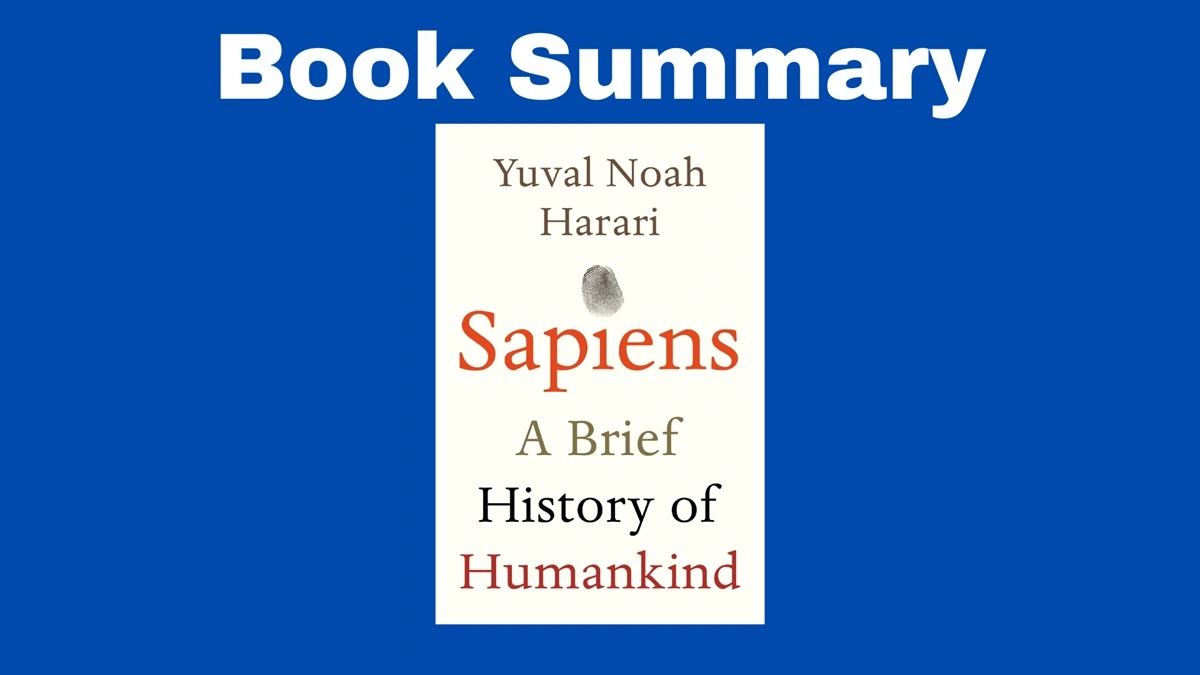
In this summary of Sapiens, you’ll read the story of humankind, spanning from the Stone Age to the 21st century. To achieve this, the book integrates ideas from both the natural sciences and the social sciences. Sapiens’ main argument is that humans came to rule the world because they can cooperate in large numbers.
Part One: The Cognitive Revolution
Chapter 1: An Animal of No Significance
The Big Bang occurred 13.8 billion years ago, giving rise to energy, time, and space. 300,000 years later, atoms combined into molecules, resulting in chemistry. Approximately 4 billion years ago, the first organisms appeared on Earth through a process known as biology. 70,000 years ago, the first Homo sapiens developed cultures, and those cultures resulted in what we call history. The course of history features three revolutions: the Cognitive Revolution started 70,000 years ago; the Agricultural Revolution 12,000 years ago; and the Scientific Revolution 500 years ago. The book focuses on how these revolutions affected humans.
The first humans appeared 25 million years ago, but at the time, they didn’t stand out from other animals. Approximately 2 million years ago, these archaic humans left their native East Africa to explore other regions and continents. Since they needed different traits to survive, they evolved into different species.
Humans have large brains compared to other mammals. Big brains are rare in nature because they require a lot of energy to maintain. For women, this was bad news because at the same time they developed narrower hips, babies developed larger heads. Death in childbirth became a problem, but to mitigate this, natural selection started favoring earlier births. This explains our social abilities. Since humans are born underdeveloped, their education is more malleable. This means human children can learn any religion or political theory. Raising children requires a tribe, so evolution also rewarded humans with stronger social ties.
Despite having tools and complex structures, humans were not at the top of the food chain for most of history. Our ancestors hunted small creatures and gathered plants while avoiding predators. Our rise to the top (which happened 100,000 years ago) was so fast that the ecosystem didn’t have time to adjust. Domesticating fire was one of the reasons why we reached the top of the food chain. Fire gave us light, warmth, and also worked as a deadly weapon against predators. The best thing fire gave us, though, was a way to cook food. Soon, Homo sapiens developed another feature that set it apart from other human species: language.
Chapter 2: The Tree of Knowledge
The Cognitive Revolution started between 70,000 and 30,000 years ago. At first, humans acquired basic linguistic abilities. While other animals communicate too, what makes our language unique is that it’s flexible. This means we can talk about the past, present, and future in a detailed way. Soon, our language helped us develop gossiping. Knowing who was sleeping with whom and who was being dishonest was vital to the survival of the tribe. But to successfully collaborate in larger groups, something else was necessary. Fictions and myths enabled sapiens to collaborate with countless strangers.
When we believe in common myths, we can cooperate successfully. Examples of myths include everything from Google to the catholic church. Most of the things we believe in (gods, nation, money, law, and human rights) don’t exist. All of these are mere ways to impart social order, and they are “figments of our collective imagination”, as the author puts it.
Since the Cognitive Revolution started, we have lived in two realities: the objective reality (our environment) and the imagined reality (the stories we tell ourselves). Over time, the imagined reality became more powerful than the objective reality. The wide range of imagined realities we’ve created gave birth to cultures. These cultures always change and develop through a process we call history. The Cognitive Revolution is a breaking point because it marks the time when biology became history.
Chapter 3: A Day in the Life of Adam and Eve
Our ancestors hunted and gathered for tens of thousands of years. This explains our eating habits, conflicts, and sexuality, among many other behaviors. Our environment might have changed drastically since then, but our psychology hasn’t. Our ancestors lived in small tribes and moved often, carrying few possessions on their backs. Dogs were the first animal we domesticated, and we used them for hunting, fighting, and as an alarm system against intruders. In return for their service, dogs got food and special care.
Members of the tribe knew each other intimately, so loneliness was rare. They gathered more than they hunted. Also, while modern humans know a lot about specific fields of expertise, early humans needed a wide range of skills to survive. Their diet was varied, and their workdays were much shorter than ours. That said, hunter-gatherers were surrounded by death. People died not just when a predator caught them, but they were killed by members of their own tribe when they became a liability.
Chapter 4: The Flood
During the Cognitive Revolution, sapiens settled in every corner of the world, adapting to new ecosystems. This marks the moment where Homo sapiens climbed to the top of the food chain, drastically changing the environment. As sapiens colonised the planet, countless species went extinct. Sadly, this ecological tragedy became a pattern that would repeat several times throughout history.
Part Two: The Agricultural Revolution
Chapter 5: History’s Biggest Fraud
Humans hunted and gathered for 2.5 million years. That changed 10,000 years ago, when humans started manipulating animal and plant species through a transition we call the Agricultural Revolution. We started sowing seeds, watering plants, plucking weeds, and leading sheep. This marks the moment when people stopped being hunter-gatherers and became farmers.
These changes brought their own set of problems. Hunter-gatherers had a stimulating and varied life. In comparison, farmers were victims of starvation and disease. Farmers also worked harder, and their diet worsened. This is why the author refers to the Agricultural Revolution as history’s biggest fraud. Like humans, domesticated animals spread around the world, but their lives were and still are miserable. We’ve been cruel to domesticated animals (except for pets). Sadly, the success of our species is tied to the suffering of others.
Chapter 6: Building Pyramids
The Agricultural Revolution was a turning point in history, a moment when Sapiens couldn’t go back to hunting and gathering. The environment also changed. While hunter-gatherers had hundreds of square miles at their disposal, farmers only had a small field and a house. This led to the first large-scale political and social systems. In other words, the first villages, towns, and cities appeared.
These cooperation networks were what the author calls “imagined orders”. These are the norms based on shared myths. Myths sustain empires, from ancient Babylon to the modern United States. The problem with imagined orders is that they can collapse if people stop believing in them, so true believers who enforce them are necessary. To believe in imagined orders, you need three components: you never admit that it is imagined, you always insist that it is the objective reality, and you educate people.
Chapter 7: Memory Overload
To cooperate, we need to follow the same rules. Most animals follow rules encoded in their genome, but unlike them, we humans need to learn rules. We can’t preserve important information in our DNA because our order is imagined. Sustaining laws, customs, and procedures takes a conscious effort.
We rely on our brains to store information, but there are some problems. First, the brain’s capacity is limited. Second, if a human dies, the information in their brain dies with them. Finally, we can only store and process specific types of information, mainly social, topographical, botanical, and zoological. In contrast, the data we manipulate now is mainly written and mathematical.
Chapter 8: There Is No Justice in History
The millennia following the Agricultural Revolution were teeming with inequality. For the longest time, there was a hierarchy where one group benefitted and another was left disempowered. Rich and poor, black and white, men and women, and so on. Hierarchies are important because they teach people how to treat one another without having to know each other. Sadly, this often leads to prejudices and downright discrimination.
Most hierarchies originated due to accidental circumstances, which explains why they vary from country to country. For instance, America brought black slaves from Africa because black people were seen as inferior for biological, medical, and religious reasons. Even when slavery was abolished, some of those myths persisted, so a vicious cycle ensued. Similarly, most societies weren’t kind to women. The only way to break this vicious cycle is to study history.
Part Three: The Unification of Humankind
Chapter 9: The Arrow of History
Human societies became incredibly complex after the Agricultural Revolution. Myths and customs accompanied people throughout their lives. They created artificial instincts that let strangers cooperate. The artificial fictions are what we call culture. Cultures have beliefs, norms, and values, but none of those elements are fixed. Cultures are in constant flux. This is the case because tensions, conflicts, and unsolvable dilemmas are part of every culture. All societies hold contradictory beliefs, which we refer to as cognitive dissonance.
Chapter 10: The Scent of Money
For the longest time, humans didn’t have money. Everything they wanted or needed, they manufactured themselves. This continued until cities and kingdoms became the norm and people could no longer rely on the kindness of strangers. To connect a large number of experts, we created money. Money easily let humans to compare the value of different commodities, exchange things, and store wealth.
Money allowed strangers to cooperate, but it also has a dark side. Since priceless values like honor, loyalty, or love lie outside the domain of the market, the problem with money is that it can corrupt human values and intimate relationships.
Chapter 11: Imperial Visions
Rome had one of the largest empires in history. Its legacy is hard to understate: our laws, politics, cuisine, and architecture are heavily influenced by the Roman Empire. The same could be said about the British Empire. An empire is a political order that rules different peoples and has flexible borders with unlimited possibilities to expand.
We now see empires as “evil engines of exploitation”, but they have been the most common form of political organization for over 2,000 years. They are also stable. Empires demand wars, enslavement, and genocide, but also prioritize philosophy, art, and charity. As difficult as it is to accept, some of the most important contributions humanity has made (from philosophy to the Taj Mahal) were possible thanks to empires. Even the languages we speak were the result of an imperial era. Empires gave us a common culture.
As tempting as it is, we can’t neatly organize history into good guys or bad guys. While most empires were founded on wars and oppression, we owe them our modern culture. It remains to be seen if a future empire will emerge. More importantly, we have to wonder if a future empire could do better than the ones we’ve had before.
Chapter 12: The Law of Religion
Alongside money and empires, religion is another unifier of humankind. When we think of religion now, we see it as a source of disagreement, but that wasn’t always the case. The role of religion was to give legitimacy to social orders and hierarchies, which tend to be fragile. With religion, we talk about laws that are absolute and indisputable, and these lead to social stability.
Harari defines religion as “a system of human norms and values that is founded on a belief in a superhuman order”. At first, hunter-gatherers turned animals and plants into spirits, but this changed in the Agricultural Revolution when these “spirits” became property.
Soon after, polytheism emerged. These are religions where the world is controlled by a group of gods. Now, we have monotheistic religions, where we worship one god instead of many. Interestingly, different interpretations of the same religion led to wars. The most notorious one was the war between catholics and Protestants in the 16th and 17th centuries in Europe. One theory supporting the increase in popularity of monotheistic religions (and the decline of polytheistic ones) is that no one wanted to worship partial powers, once others started believing that there is a supreme god.
Polytheism not only led to monotheist religions, but also to dualistic ones. Dualistic religions believe in two opposing powers: good and evil. Monotheism and dualism are somewhat controversial, but humans still managed to combine the two in a religion called syncretism.
Where in the West people believe in supernatural entities, the East saw the rise of religions that disregarded gods altogether. These are what we call natural-law religions because their gods were subject to the laws of nature. Examples include Buddhism, Daoism, Confucianism, Stoicism, and so on.
During the last 300 years, religions have lost their importance. That is, unless we consider liberalism, Communism, capitalism, and Nazism as religions. What all of these have in common is that they worship men instead of god. This is also how human rights emerged.
Chapter 13: The Secret of Success
Eventually, every man and woman had access to money, empires, and religions, turning the world into a single global society. Although we know how we got to this place, it’s harder to explain why. History is chaotic. Many complex forces are at work, and anything can alter the ultimate outcome. History is what we call a “level two” chaotic system. Level one chaos does not react to predictions about it, but level two chaos does. If we could forecast history with 100% accuracy, it would react to the forecast, so our prediction would change.
Studying history is important nonetheless. Not because it will enable us to make accurate predictions, but because it helps us understand the present as something unnatural. Likewise, no one can prove that the choices we’ve made along the way were the best ones.
Part Four: The Scientific Revolution
Chapter 14: The Discovery of Ignorance
The last 500 years have seen unprecedented growth. We have supercomputers in our pockets, humans have landed on the moon, we’ve gotten rid of most infectious diseases, and the list of achievements is endless. The defining moment of the past 500 years was the detonation of the atomic bomb in New Mexico. It showed that humans could end history if they wanted. Everything that led to that moment is what we call the Scientific Revolution.
At some point, governments realized that they could increase their capabilities by giving resources to science. Science revolutionized the world because it showed a willingness to admit ignorance. The Scientific Revolution was possible because we accepted that we didn’t have the answer to the most important questions. To understand the universe, we needed to connect observations through coherent theories using mathematics. We now live in a world that’s never seen this much progress, and our lives are improving all the time. The biggest problem science has to solve is death, but it remains to be seen if this is feasible and how long it will take.
Chapter 15: The Marriage of Science and Empire
Most scientific discoveries were made by empires. Empires gave new discoveries military and political value. This led to the expansion of European empires whose economies strengthened considerably in the 1800s and have influenced the modern world we live in. Europe succeeded not just because it had technological inventions, but because it had values, myths, and socio-political structures that took hundreds of years to develop. Modern science and capitalism replaced imperialism and gave Europe the edge it needed to expand. This expansion didn’t mean just territory, but also knowledge.
Arguably, this thirst for knowledge started in 1492 when Christopher Columbus set foot in what we now call the Bahamas. To control vast new territories, Europeans needed to gather as much information as possible. The first field they studied extensively was cartography, since they had missed an entire continent. To develop a new and accurate world map, Europeans had to explore and conquer through expeditions. As we now know, these expeditions led to genocide.
Chapter 16: The Capitalist Creed
Building empires and promoting science would have been impossible without money. The global economy has been growing steadily in the modern era. This is the case because money no longer represents tangible objects in the present. It represents imaginary objects in the future instead. We call that credit. Credit, as the author describes it, lets you “build things in the present using future income.”
An important part of capitalism involves investing capital (money, goods, and resources) in production. This means that profits are reinvested in production to generate more profits. This cycle repeats endlessly. Capitalism grew to the point that it became a religion of sorts. There are risks to giving free rein to markets. Free and unsupervised markets can turn into monopolies or harm their workforces.
Chapter 17: The Wheels of Industry
Apart from trust in the future and capitalists reinvesting profits in production, economic growth requires energy and raw materials, which are limited. Before, the only unlimited energy source we relied on was our bodies or the bodies of animals. That’s how we ploughed fields, transported goods, or moved around. This changed when humans invented the steam engine. Harnessing energy to our advantage eventually led to the creation of the atomic bomb. Enormous sources of energy surround us. All we need is the knowledge to convert it to our needs.
We also have industrialized farms. The problem is that we now treat animals as cogs in a machine, completely disregarding their capacity to experience pain. Animals have psychological needs, and if those aren’t met, they suffer.
The capitalist economy we live in also led to consumerism. For the first time in history, most people can now afford different luxuries. Consumerism may sound selfish and decadent, but we take part in it all the time, and the economy thrives as a consequence.
Chapter 18: A Permanent Revolution
The world we live in has changed drastically to fit our needs. This means that habitats were destroyed and some species went extinct. The fear of ecological degradation is real.
Another change that the Industrial Revolution brought was the adoption of time. Countries now live according to an artificial clock rather than sunrise-to-sunset cycles. Broadcast media reinforced this. Having access to the time changed how we lived.
These changes made the idea of family and community less important. Before the Industrial Revolution, family was everything, and without it, an individual would die. Over time, states and markets strengthened to the point where you can marry whoever you want, live wherever you want, and work whatever job suits you best. This freedom comes at a price, though, since the loss of strong families makes us feel alienated.
There have also been radical changes in the social order. We now live in a world that’s in total flux. If something characterizes this new world, it’s prosperity. More people die in traffic accidents than in wars. Violence has been in decline, while the state has risen. To be clear, wars do happen, but they are no longer the norm.
Chapter 19: And They Lived Happily Ever After
The last 500 years have seen unimaginable progress, but we’re not happier. Happiness is not a product of familiar factors. There are many other factors that make an impact on our happiness, such as community, religion, and a bond with nature. Ultimately, happiness is a combination of family, having enough money and being healthy. Interestingly, family and community are more important than health and money in terms of happiness. Marriage is particularly important.
More than anything, happiness is a matter of expectations. The problem is the message the media and advertising give us. You can now compare yourself to millions of people online. This means there’s always someone richer or prettier than you. Biologists, on the other hand, believe that happiness is mainly determined by biochemistry, but they also claim that psychological and sociological factors influence it as well.
Chapter 20: The End of Homo Sapiens
Homo sapiens are not breaking the laws of natural selection by engineering living beings. We might revolutionize the game of life. We’re replacing natural selection with intelligent design. This could lead to either biological engineering, cyborg engineering, or the engineering of inorganic life.
Biological engineering is human intervention on a biological level to modify an organism’s shape, capabilities, needs, or desires. The clearest example is castration. Cyborg engineering involves combining organic and inorganic parts. For example, humans with bionic hands. Other examples include eyeglasses, pacemakers, or even computers, since we’ve used them to relieve our brains of data storage burdens. Finally, we can change the laws of life by engineering inorganic beings. Examples include computer programs that can evolve by themselves.
Afterword: The Animal that Became God
We went from being an insignificant animal to being masters of the planet. For every achievement, we’ve also brought suffering to the world. Even as we’re making progress in terms of the human condition, other animals live in misery. We’ve advanced, but don’t know where we’re going. We’re self-made gods, and that’s dangerous.
Further reading
If you liked this summary of Sapiens, you might also like: